Intel Publishes First Microcode Replace for Raptor Lake Stability Challenge, BIOSes Going Out Now

Try our newest merchandise


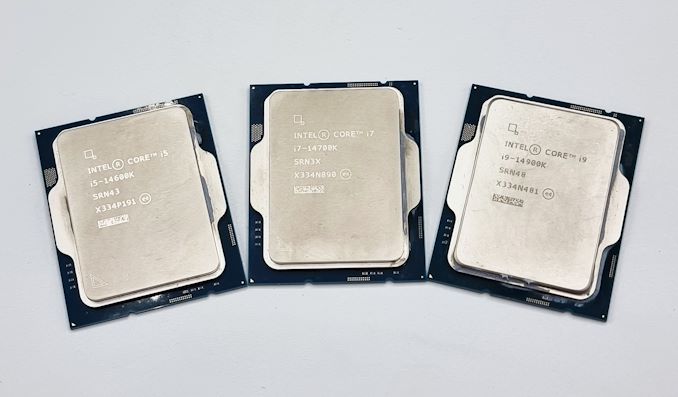
Following Intel’s run of economic woes and Raptor Lake chip stability points, the corporate might use some excellent news on a Friday. And this week they’re delivering simply that, with the primary model of the eagerly awaited microcode repair for desktop Raptor Lake processors – in addition to the primary detailed rationalization of the underlying challenge.
The brand new microcode launch, model 0x129, is Intel’s first stab at addressing the elevated voltage challenge that has seemingly been the reason for Raptor Lake processor degradation over the previous yr and a half. Intel has been investigating the difficulty all yr, and after a sluggish begin, in latest weeks has begun making extra vital progress, figuring out what they’re calling an “elevated working voltage” challenge in high-TDP desktop Raptor Lake (13th & 14th Technology Core) chips. Again in late July the corporate was concentrating on a mid-August launch date for a microcode patch to repair (or quite, forestall) the degradation challenge, and simply forward of that deadline, Intel has begun transport the microcode to their motherboard companions.
Even with this new microcode, nevertheless, Intel isn’t performed with the steadiness challenge. Intel remains to be investigating whether or not it’s doable to enhance the steadiness of already-degraded processors, and the general tone of Intel’s announcement may be very a lot that of a beta software program repair – Intel received’t be submitting this particular microcode revision for distribution through working system updates, for instance. So even when this microcode is profitable in stopping ongoing degradation, it appears that evidently Intel hasn’t closed the guide on the difficulty solely, and that the corporate is presumably working in direction of a repair appropriate for wider launch.
Capping At 1.55v: Elevated Voltages Beget Elevated Voltages
So simply what does the 0x129 microcode replace do? Briefly, it caps the voltage of affected Raptor Lake desktop chips at a still-toasty (however in spec) 1.55v. As famous in Intel’s earlier bulletins, extreme voltages appear to be at the reason for the difficulty, so capping voltages at what Intel has decided is the right restrict ought to forestall future chip harm.
The corporate’s letter to the neighborhood additionally outlines, for the primary time, simply what’s going on beneath the hood with degraded chips. These chips which have already succumbed to the difficulty from repeated voltage spikes have deteriorated in such a manner that the minimal voltage wanted to function the chip – Vmin – has elevated past Intel’s authentic specs. In consequence, these chips are now not getting sufficient voltage to function.
Seasoned overclockers will little doubt discover that it is a acquainted story, as this is without doubt one of the ways in which overclocked processors degrade over time. In these circumstances – because it seems to be with the Raptor Lake challenge – extra voltage is required to maintain a chip steady, significantly in workloads the place the voltage to the chip is already sagging.
And whereas all indicators level to this degradation being irreversible (and a variety of RMAs in Intel’s future), there’s a ray of hope. If Intel’s evaluation is appropriate that degraded Raptor Lake chips can nonetheless function correctly with a better Vmin voltage, then there’s the opportunity of saving no less than a few of these chips, and bringing them again to stability.
This “Vmin shift,” as Intel is looking it, is the corporate’s subsequent investigative goal. Based on the corporate’s letter, they’re aiming to supply updates by the “finish of August.”
Within the meantime, Intel’s keen motherboard companions have already begun releasing BIOSes with the brand new microcode, with ASUS and MSI even leaping the gun and sending out BIOSes earlier than Intel had an opportunity to correctly announce the microcode. Each distributors are releasing these as beta BIOSes, reflecting the final early nature of the microcode repair itself. And whereas we count on most customers will need to get this microcode in place ASAP to mitigate additional harm on affected chips, it will be prudent to deal with these beta BIOSes as simply that.
Alongside these traces, as famous earlier, Intel is just distributing the 0x129 microcode through BIOS updates at the moment. This microcode is not going to be coming to different programs through working system updates. At this level we nonetheless count on distribution through OS updates to be the top sport for this repair, however for now, Intel isn’t offering a timeline or different steering for when that may occur. So for PC fanatics, no less than, a BIOS replace is the one approach to get it for now.
Efficiency Affect: Usually Nil – However Not At all times
Lastly, Intel’s message additionally supplies a little bit of steering on the efficiency impression of the brand new microcode, based mostly on their inner testing. Beforehand the corporate has indicated that they anticipated no vital efficiency impression, and based mostly on their expanded testing, by and huge this stays the case. Nevertheless, there are going to be some workloads that undergo from efficiency regressions in consequence.
To date, Intel has discovered a few workloads the place they’re seeing regressions. This consists of PugetBench GPU Results Rating and, on the gaming facet of issues, Hitman 3: Dartmoor. In any other case, just about the whole lot else Intel has examined, together with widespread benchmarks like Cinebench, and main video games, should not displaying efficiency regressions. So the general consequence of the repair isn’t fairly a spotless restoration, but it surely’s additionally not resulting in widespread efficiency losses, both.
As for AnandTech, we’ll be digging into this on our personal benchmark suite as time permits. We’ve got yet one more CPU launch arising subsequent week, so there’s no scarcity of labor to be performed within the subsequent few days. (Sorry, Gavin!)
Intel’s Full Assertion
For all Intel Core thirteenth/14th Gen desktop processor customers: This patch is being distributed through BIOS replace and won’t be accessible by means of working system updates. Intel is working with its companions to make sure well timed validation and rollout of the BIOS replace for programs at the moment in service.
Instability Evaluation Replace – Microcode Background and Efficiency Implications
Along with prolonged guarantee protection, Intel has launched three mitigations associated to the instability challenge – generally skilled as constant utility crashes and repeated hangs – to assist stabilize buyer programs with Intel Core thirteenth and 14th gen desktop processors:
- Intel default settings to keep away from elevated energy supply impression to the processor (Could 2024)
- Microcode 0x125 to repair the eTVB challenge in i9 processors (June 2024)
- Microcode 0x129 to handle elevated voltages (August 2024)
Intel’s present evaluation finds there’s a vital improve to the minimal working voltage (Vmin) throughout a number of cores on affected processors on account of elevated voltages. Elevated voltage occasions can accumulate over time and contribute to the rise in Vmin for the processor.
The most recent microcode replace (0x129) will restrict voltage requests above 1.55V as a preventative mitigation for processors not experiencing instability signs. This newest microcode replace will primarily enhance working situations for Ok/KF/KS processors. Intel can also be confirming, based mostly on intensive validation, all future merchandise is not going to be affected by this challenge.
Intel is constant to research mitigations for situations that can lead to Vmin shift on probably impacted Intel Core thirteenth and 14th Gen desktop processors. Intel will present updates by finish of August.
Intel’s inner testing – using Intel Default Settings – signifies efficiency impression is inside run-to-run variation (eg. 3DMark: Timespy, WebXPRT 4, Cinebench R24, Blender 4.2.0) with a couple of sub-tests displaying average impacts (WebXPRT On-line Homework; PugetBench GPU Results Rating). For gaming workloads examined, efficiency has additionally been inside run-to-run variation (eg. Cyberpunk 2077, Shadow of the Tomb Raider, Whole Struggle: Warhammer III – Mirrors of Insanity) with one exception displaying barely extra impression (Hitman 3: Dartmoor). Nevertheless, system efficiency relies on configuration and a number of other different elements.
For unlocked Intel Core thirteenth and 14th Gen desktop processors, this newest microcode replace (0x129) will not forestall customers from overclocking in the event that they so select. Customers can disable the eTVB setting of their BIOS in the event that they want to push above the 1.55V threshold. As all the time, Intel recommends customers proceed with warning when overclocking their desktop processors, as overclocking might void their guarantee and/or have an effect on system well being. As a common finest follow, Intel recommends clients with Intel Core thirteenth and 14th Gen desktop processors make the most of the Intel Default Settings.
In gentle of the lately introduced prolonged guarantee program, Intel is reaffirming its confidence in its merchandise and is dedicated to creating positive all clients who’ve or are at the moment experiencing instability signs on their thirteenth and/or 14th Gen desktop processors are supported within the change course of. Customers experiencing constant instability signs ought to attain out to their system producer (OEM/System Integrator buy), Intel Buyer Help (boxed processor), or place of buy (tray processor) additional help.
-Intel Neighborhood Put up