Take a look at our newest merchandise


|
SiFive HiFive Premier P550
|
|||

|

|
||
Over the past decade-plus, two CPU instruction set architectures have vied for dominance in shopper computing, whether or not in smartphones and tablets or high-performance PCs: x86 and Arm, or extra particularly x86-64 vs Arm64. Nevertheless, each of those options are encumbered by complicated and probably prohibitive licensing restrictions. A 3rd structure (disregarding area of interest choices like MIPS and POWER) is attempting to interrupt via the mainstream ISA duopoly, nonetheless, and that is RISC-V.
Presumably essentially the most outstanding RISC-V vendor available on the market presently is SiFive, which shall be our take a look at car for on the next pages. You would possibly recall the SiFive HiFive Unmatched developer board that we checked out intently late final yr. It was an fascinating, if not significantly quick, proof-of-concept for desktop RISC-V improvement kits. Whereas it was able to working RISC-V software program, its simplistic design strategy resulted in lower than strong efficiency. Nevertheless, SiFive has pressed on with its CPU designs. Right this moment’s entry is the following evolution of RISC-V edge computing improvement boards, the SiFive HiFive Premier P550.
SiFive HiFive Premier P550 Specs
The HiFive Premier P550 is predicated on the ESWin EIC7700X chip, which makes use of SiFive’s RISC-V design. The chip is put in on a HiFive Premier P550 system-on-a-module (SoM) that is available in a four-core configuration, which matches the variety of cores discovered on the earlier HiFive Unmatched. The SoC sports activities a triple-issue, out-of-order design that ought to make shopper computing a lot sooner than the Unmatched board. These cores run at a comparatively conservative 1.4 GHz, which is able to hamper its efficiency in comparison with most different designs. The SoC has a 32 kB L1 cache, 256 kB personal L2 cache, and 4MB shared L3 cache, that are important will increase total, in comparison with the earlier SiFive board.
The HiFive Premier P550 consists of each an built-in GPU and NPU that are enabled, however the NPU does not have any software program assist simply but. The GPU is a PowerVR AXM-8-256, which makes use of a shared reminiscence structure like each different built-in GPU. The NPU boasts a most processing energy of 20 TOPS, about half of what Microsoft requires for its AI PCs, however nonetheless highly effective sufficient to assist out with AI processing, as soon as software program assist is in place. Once more, that is about making software program usable on an actual RISC-V platform, not all-out efficiency. Properly, not but, anyway.
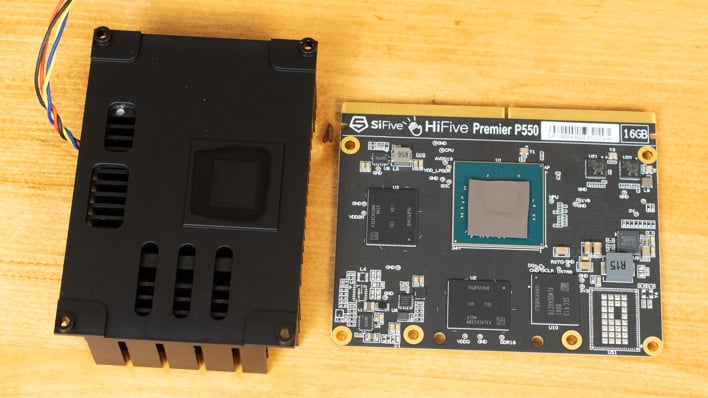
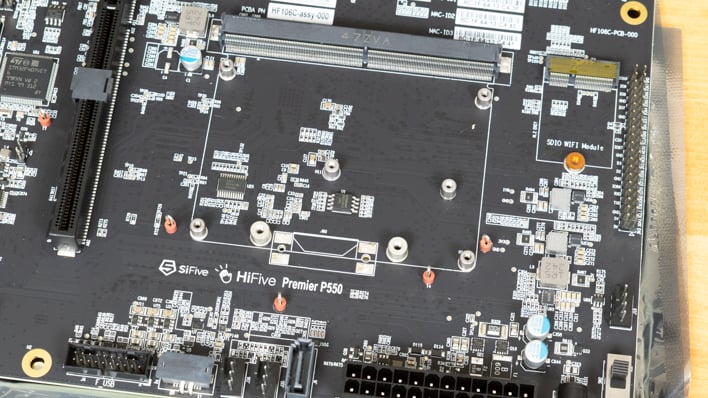
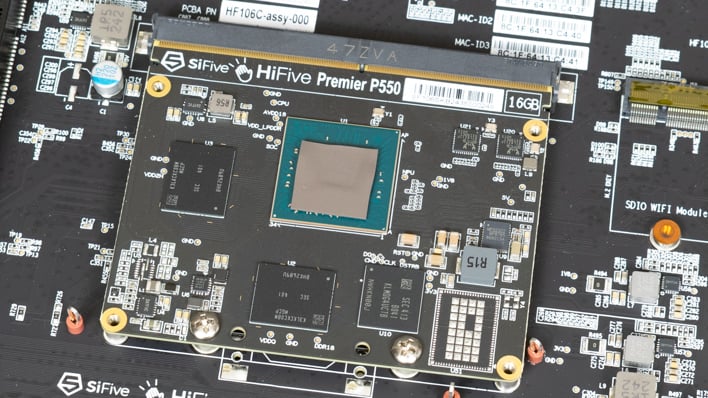
Our take a look at unit comes with the Premier P550 module pre-installed with 16 GB of LPDDR5 reminiscence and 128 MB of eMMC storage with Ubuntu preinstalled. The P550 module is concerning the dimension of a Raspberry Pi 5, however has an edge connector like a DIMM that plugs into the motherboard. This model prices $399 (module and motherboard included) at retail, though there’s a $499 model with 32GB of reminiscence obtainable for buy, as nicely.
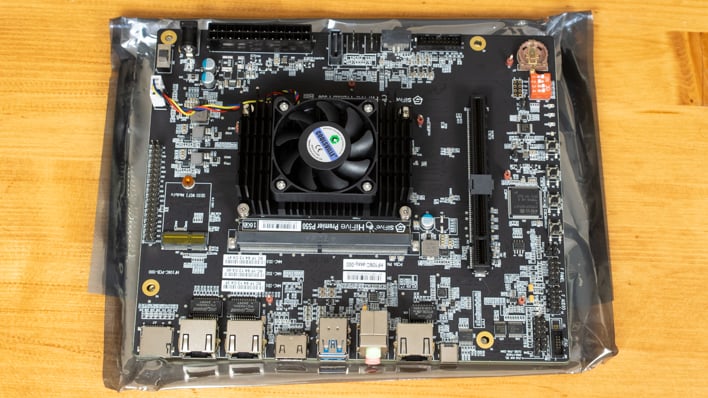
The board has what you would possibly count on from a contemporary mini-ITX or mini-DTX providing, together with a single PCI Categorical x16 physical-sized x4 slot, rear and entrance panel USB 3.0 ports, onboard audio and video, and a pair of Gigabit Ethernet ports. There’s a 3rd RJ-45 connector for a administration community that runs at 100 megabits, as nicely. And similar to the HiFive Unmatched earlier than it, the HiFive Premier P550 has ATX energy enter and entrance panel headers for normal ATX switches. It additionally has a normal 5.5mm 12v barrel connector for embedded functions, as nicely.
SiFive had been promoting a model of this board that runs a Yocto-based embedded Linux distribution that makes use of XFCE for window administration and Dandified Package deal Supervisor for putting in different software program. Nevertheless, extra lately the corporate has changed its vanilla Debian base (the identical distribution upon which the official Raspberry Pi OS is predicated) with a fairly simple RISC-V port of Ubuntu 24.04.1 LTS. House owners of earlier iterations can improve their board utilizing an SD card and a few terminal instructions. Nevertheless, since our unit shipped with Ubuntu, none of that was essential, at first. We’ll clarify once we get to the construct part.
Exploring SiFive HiFive Premier P550 Use Instances
Let’s reply the plain query: what’s the HiFive Premier P550 for? Not like plenty of small-form-factor computer systems with unique (as in, non-x86) instruction set architectures, this isn’t simply an embedded platform to slap into service and by no means take a look at once more. In different phrases, it is not a Raspberry Pi competitor or the like. Quite, it is a improvement board and a validation platform. It is also the quickest RISC-V board available on the market, which implies that for builders which are working to deliver software program to the ISA, it is doubtless the best choice to check on actual {hardware}.
Up till lately, the overwhelming majority of RISC-V software program improvement has been performed with QEMU digital machines working the RISC-V ISA to see if “in principle” software program might be compiled and run on RISC-V {hardware}. The HiFive Unmatched was a pleasant proof of idea that truly ran RISC-V software program natively. The Premier P550 takes {that a} step additional and offers sufficient shopper computing efficiency to offer RISC-V software program a very good exercise, and likewise give it entry to actual {hardware} peripherals like our Radeon GPU, for instance.
And there is a ton of software program that is making its solution to RISC-V. As we get to our testing outcomes, you will see there’s truly various software program that runs on the platform. We did not must compile something from supply for our productiveness and developer checks, as RISC-V native binaries exist already for all the things we would have liked to cowl.
The mere existence of the Premier P550 implies that, hopefully, working RISC-V binaries in QEMU will develop into much less frequent, whereas focusing on actual {hardware} will improve. Ubuntu is a fairly full-fat distribution, and meaning we will train this factor a bit. So let’s discover out subsequent.
Constructing a HiFive Premier P550 PC
The enjoyable factor concerning the HiFive Premier P550 is which you could, for essentially the most half, simply use off-the-shelf elements. We used what we had mendacity round, which features a Cooler Grasp MasterBox Q300L micro-ATX case and a Corsair RM850e energy provide, the latter of which is a bit overkill. The board has the usual headers for USB 3.0 entrance ports, entrance panel audio, and ATX customary energy and reset buttons together with an influence and storage exercise LEDs. In that regard, placing it collectively was virtually too simple. And that is an excellent factor.
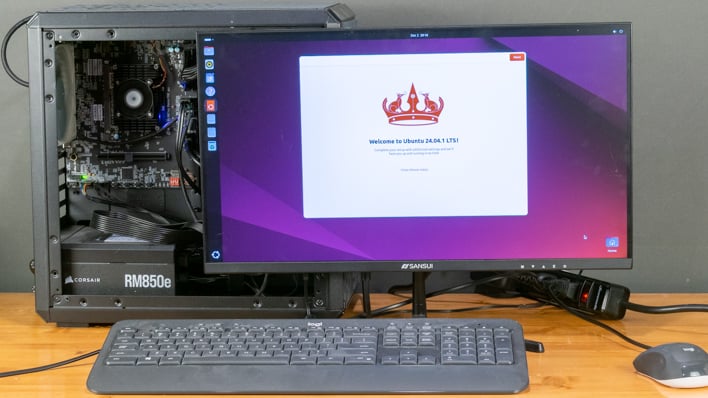
The preliminary startup course of is fairly simple to any Linux veteran; after a fast power-on self-test, the HiFive Premier P550 initializes into the GRUB boot supervisor, which after a number of seconds boots into Ubuntu by default. On first login, we had been prompted to alter our password and we had been good to go. The Ubuntu-themed Gnome desktop is extraordinarily acquainted.
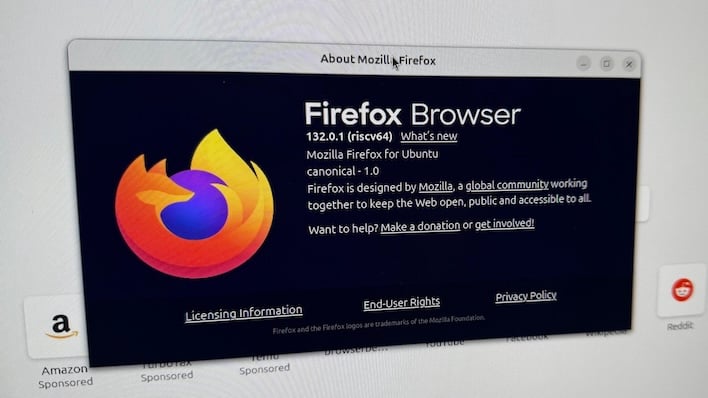
That is the place we might play with totally different peripherals, all of which had been acknowledged and able to go in Ubuntu, such as you’d count on from any desktop. Webcams, USB microphones, thumb drives, and even the onboard SATA port labored simply as anticipated. Ubuntu consists of Mozilla Firefox because the default internet browser, which appeared to work advantageous in some light-duty shopping.
Whereas the HiFive Premier P550 module has a PowerVR AXM built-in GPU (which has Vulkan drivers, even!), we took the chance to make use of a discrete GPU. The open-source Mesa drivers that include the system additionally assist older (Polaris and older) graphics playing cards. I had this dormant XFX Radeon RX 590 Fatboy (impolite) laying round, so I slapped it in. This required renaming the X config that drives the PowerVR GPU earlier than shutting down and doing the swap. That is a bit extra effort than what you’d must do on an x86 Linux PC, nevertheless it’s actually not that huge of a deal for the supposed viewers of software program builders.
The software program that is nonetheless lacking from the RISC-V ecosystem does sting a bit, no matter who you’re. Principally, if it does not ship with Ubuntu, you are in all probability going to must compile it from supply. Whereas having Firefox is good, Google’s Chrome browser is the most well-liked browser on the planet proper now, and it hasn’t been delivered to RISC-V but. Working Home windows software program on Linux has made nice strides during the last couple of years, however you will have to run Box64 or construct Wine your self, after which will probably be working in an x86 compatibility layer, which hurts efficiency. Although that is advantageous; this isn’t a client system.
At this level, we began contemplating what checks we might wish to run, after which bother got here on the lookout for us. Flip the web page to study our self-inflicted catastrophe and the comparatively easy repair that SiFive gives…
![[2-Pack] USB C Wall Charger, 50W 5-Port PD Fast USB C Charging Block,2USB C+3USB A Multiport Plug,Type C Power Adapter Brick Cube for iPhone 16/15/14/13/12/Pro Max/XS,iPad,for Switch,Samsung,Ultra 2](https://m.media-amazon.com/images/I/6113+rPNNeL._AC_SL1500_.jpg)
![[6 Pack] CLOUDY BAY 4inch Smart WiFi LED Recessed Lights,RGBCW Color Changing Recessed Lighting,Compatible with Alexa and Google Home Assistant,10W 2700K-6500K,CRI90+ Wet Location,White Finish](https://m.media-amazon.com/images/I/71j1JN-Wa3L._AC_SL1500_.jpg)