In 1933, the Ohio River spilled over, flooding Louisville, Kentucky.
Franklin Roosevelt blamed soil erosion and forests misplaced to the timber business, which have been among the many causes conservation was one of many new president’s high priorities.
Inside months, the US Military and different businesses have been placing collectively plans for Roosevelt’s “tree military,” because the Civilian Conservation Corps, or CCC, grew to become recognized. The aim was to have 250,000 teenagers and younger males in camps across the nation by July 1.
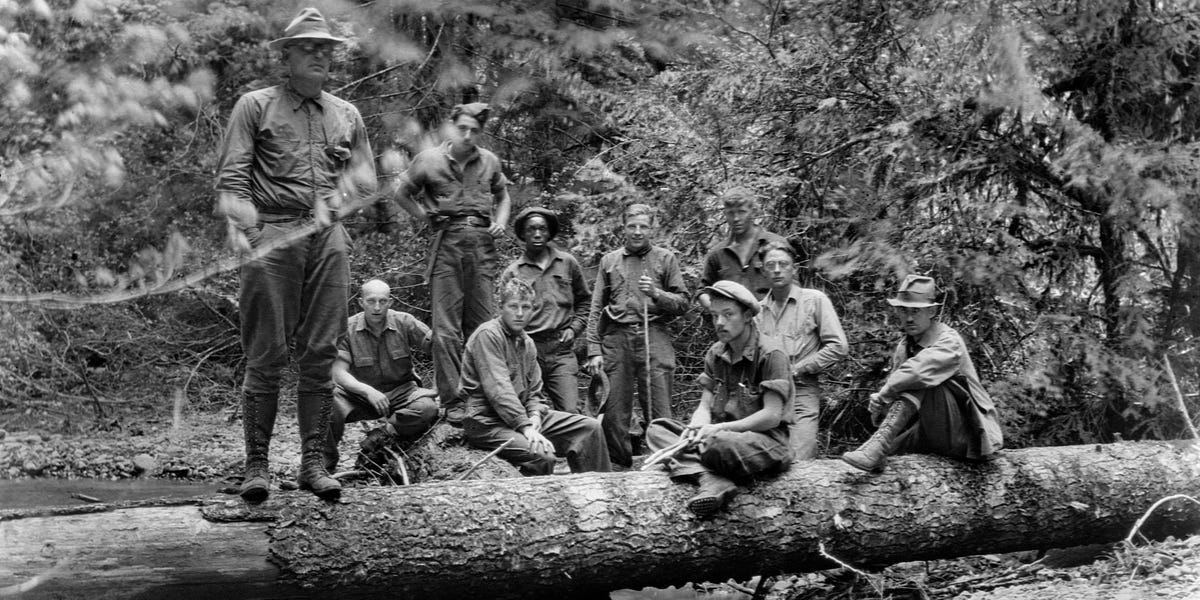
The CCC did not simply plant billions of timber. They fought fires, created and added entry to state and nationwide parks, and put up phone wires.
“They constructed every little thing from a number of the most well-known constructions in parks within the nation to issues in your individual yard that you simply may not even concentrate on,” Neil Maher, a historian on the New Jersey Institute of Expertise, advised Enterprise Insider.
Ecology was in its infancy as a science, and far of the work was executed with the intention of benefiting people as a substitute of preserving or defending crops, animals, and waterways. The aim was to make use of these assets as effectively as attainable.
Over 80 years after this system resulted in 1942, the CCC’s fingerprints are everywhere in the US’ parks, from the billions of timber planted to trails hikers use every single day.
Here is how the enrollees basically modified the panorama of the US throughout the nation.
The CCC was a part of FDR’s New Deal.
New York Instances Co./Getty Photos
When FDR took workplace, the Nice Despair was gripping the US. Over 12 million individuals have been out of labor, and Roosevelt wished to place them to work. The thought was to marry conservation tasks that paid the employees properly.
The CCC might give attention to forestry, stopping soil erosion, flood management, and comparable tasks that might keep away from monetary loss, he wrote to congress in March 1933: “That is introduced dwelling by the information we’re receiving at this time of huge harm brought on by floods on the Ohio and different rivers.”
He summed up the twin objectives by writing, “It can preserve our treasured pure assets. It can pay dividends to the current and future generations.”
Typically described as Roosevelt’s pet mission, the CCC mirrored his view of conservation.
Bettmann/Getty Photos
“Except we preserve an enough materials foundation for our civilization, we can not preserve the establishments during which we take so nice and so only a satisfaction; and to waste and destroy our pure assets means to undermine this materials foundation,” Theodore Roosevelt mentioned in 1907. FDR’s notions of conservation have been just like his distant cousin’s.
FDR grew up on his household’s 1,200-acre property in Hyde Park, New York. There, he noticed firsthand how clearing land led to erosion. In 1912, he began planting what would develop into over half 1,000,000 timber on the property over the course of his lifetime.
Within the Nineteen Thirties, many conservationists fearful that people have been misusing pure assets.
Bettmann/Getty Photos
Gifford Pinchot was the primary head of the US Forest Service, which was shaped in 1905. He noticed conservation as “the event and use of the earth and all its assets for the enduring good of males,” he wrote in his autobiography. Pinchot’s concepts influenced Roosevelt’s personal.
“The thought was to not protect them or not contact them,” Maher mentioned of the US’ timber, rivers, and soil. “The thought was to very a lot use them, however to do it in a accountable manner.”
That meant planting timber that could possibly be reduce down later, however their roots would additionally sluggish erosion.
The Corps began work nearly instantly.
CORBIS/Corbis by way of Getty Photos
FDR took workplace in early March. By the tip of the month, Congress had handed the Emergency Conservation Work Program Act. Enrollees have been already signing up in early April, and Camp Roosevelt, the CCC’s first, began up quickly after close to Luray, Virginia.
In only a few brief months, the Corps had over 1,400 camps all through the nation. The 275,000 enrollees, as they have been referred to as, greater than met Roosevelt’s aim to have 250,000 males working by July 1, 1933.
The camps’ tough logistics required help from the Military, Nationwide Parks Service, and different businesses.
Library of Congress/Corbis/VCG by way of Getty Photos
The US Military was answerable for every little thing from meals to transportation to medical care. “The Military is their supplier and tailor, physician and trainer, non secular advisor and paymaster,” one CCC promoter wrote.
In the meantime, the Division of Labor was accountable for recruitment, and the Forest Service and NPS headed the conservation work and park improvement.
Robert Fechner grew to become this system’s first director.
The CCC was largely made up of males of their late teenagers and early 20s.
Bettmann by way of Getty Photos
There have been just a few necessities for enrollment. One was the age restrict, 18 to 25. Solely males have been employed, and so they needed to be residents. Although the enrollees could not be married, they needed to have members of the family on aid, receiving monetary help.
“Fairly a variety of youngsters acquired into the CCC mendacity about their age,” Alexander mentioned. “Again then, it was attainable for a 15-year-old to faux to be 18.”
These have been short-term jobs. They may solely work for 2 six-month stints. Later, the quantity was elevated to a few, and the age limits have been raised.
Older veterans and native skilled males (LEMs) additionally joined the CCC in numerous roles and did not have to fulfill the identical age or marriage restrictions. The native males sometimes had expertise in forestry work.
Younger Corps employees earned $30 a month, most of which was despatched to their households.
Dorris Bumgarner/Nationwide Park Service
The lads solely stored between $5 and $7 of their paycheck. The remainder went to their mother and father and siblings; teenagers and younger males who didn’t have households weren’t in a position to be a part of this system.
“The CCC may very properly have helped a variety of them, however there was a prejudice in opposition to transient youth as being socially inferior to those that got here from households,” Alexander mentioned.
Earnings they stored for themselves could be spent at native companies throughout journeys to city or on sweet, cigarettes, cleaning soap, ice cream, and different objects from the camp’s canteen.
Because the economic system improved, the principles modified so the employees might preserve the cash they earned.
Within the early days, enrollees needed to put up tents and get bodily match.
CORBIS/Corbis by way of Getty Photos
The Military began conditioning camps for the brand new CCC recruits. The work was going to be demanding, in order that they needed to put together for it.
The primary camps used six-person tents warmed with wooden stoves. Later development included garages, mess halls, barracks, recreation facilities, and different buildings.
Planting timber was only one aim of the CCC.
CORBIS/Corbis by way of Getty Photos
Along with filling basic positions that helped the camps run easily, like drivers and kitchen employees, CCC members may plant timber, construct constructions, survey wildlife, or carry out different duties relying on the place they have been stationed. Civilian supervisors within the forestry and parks departments oversaw this kind of work.
“They weren’t given army coaching, however there was a point of militaristic-style self-discipline,” Benjamin Alexander, writer of “The New Deal’s Forest Military: How the Civilian Conservation Corps Labored,” advised BI.
Some roles have been harmful. Males drowned or died combating fires.
Once they weren’t working, there have been actions to fill their free time.
FPG/Hulton Archive/Getty Photos
The lads began early within the morning and labored eight-hour days, 5 days every week. Throughout their off-duty hours, there have been books to learn, the radio to hearken to, and board video games to play. Watching motion pictures was additionally a preferred strategy to move the time.
At night time, musically inclined enrollees could possibly be heard strumming banjos or guitars or taking part in accordions and concertinas.
Generally Corps members acquired go away time to go to dwelling or passes to enter the closest city.
Boxing, baseball, swimming, and different sports activities stuffed the lads’s time.
Bettmann/Getty Photos
Historian David J. Nelson in contrast the CCC expertise to summer season camp relatively than Military life.
Enjoying sports activities might construct unity in addition to stop boredom. Boxing matches have been an unofficial strategy to settle arguments and doubtlessly put together the lads for fight, in accordance with Nelson.
Some noticed camp life as the right alternative to teach the younger males.
CORBIS/Corbis by way of Getty Photos
Night time lessons have been one other strategy to occupy the enrolled males. As many as 110,000 CCC members realized to learn and write throughout this system, in accordance with one estimate.
Different males had already began attending school and may be capable of proceed learning physics or literature, even when it was informally. Close by libraries and universities generally offered books or instructors.
Enrollment diverse throughout camps, and a few males confirmed up as a result of “there was nothing else to do,” one participant later mentioned. Many ultimately misplaced curiosity. For others, although, it was an opportunity to get coaching or study one thing new. The programs supplied coated every little thing from typing to beekeeping to drama.
Enrollees raved concerning the meals.
Bettmann/Getty Photos
Within the midst of the Nice Despair, most of the males arrived at camp undernourished. The Military equipped as a lot as 5 kilos of meals a day. After just a few weeks, most gained weight, a mean of 12 kilos.
A typical breakfast may encompass eggs, bacon, espresso, cereal, and bread. Dinner could be burgers, potatoes, and coleslaw.
“I by no means ate so good in my life,” one enrollee later mentioned.
Roosevelt wished the nation’s younger males to be within the contemporary air.
PhotoQuest/Getty Photos
For FDR, there was a hazard in having massive numbers of males of their teenagers and 20s with out jobs.
“There’s at all times the governmental concern that too many unemployed, disaffected youth could possibly be a recruiting floor for political extremists, each communists and fascists,” Alexander mentioned.
Conserving them busy would have “ethical and non secular worth,” Roosevelt mentioned: “We are able to take an enormous military of those unemployed out into healthful environment.”
The Military created segregated camps for Black CCC employees.
CORBIS/Corbis by way of Getty Photos
When Congress handed the act creating the CCC, Oscar DePriest, its solely Black member, included language that “no discrimination shall be made on account of race, coloration, or creed” when hiring employees.
Younger Black males have been in a position to enroll, however the Military continued its segregation insurance policies in its CCC camps. Many from northern states like Minnesota have been despatched to the South. An editorial in Minneapolis’ “Spokesman” newspaper referred to as these transfers “a vicious transfer to ship our boys into states which subscribe utterly to Jim Crow traditions.”
In each the North and South, white communities generally objected to Black CCC items organising of their neighborhood. “The federal government truly had issue finding the Black camps for that motive, primarily based on nothing apart from paranoia,” Alexander mentioned.
Director Fechner then suppressed Black males’s enrollment, a coverage that stayed in place till 1941, in accordance with the NPS.
A separate group, referred to as the CCC-ID, employed Indigenous employees.
CORBIS/Corbis by way of Getty Photos
What grew to become referred to as the Civilian Conservation Corps—Indian Division, or CCC-ID, began in June 1933. Run by the Bureau of Indian Affairs, it had barely totally different necessities than the unique model.
Males who have been older than 25 might enroll, and lots of lived at dwelling as a substitute of in camps. Initiatives have been comparable, together with dam and fence development, stringing phone strains, constructing roads, and combating fires. When this system ended, round 80,000 Indigenous individuals had been concerned.
Ladies could not enroll within the CCC.
Bettmann by way of Getty Photos
First woman Eleanor Roosevelt spearheaded “She-She-She” camps for about 8,500 unemployed ladies. These summer season applications passed off from 1933 to 1937 and have been meant to “present healthful employment and helpful instruction amid healthful environment for needy younger ladies.”
Their work was very totally different, in accordance with the New England Historic Society. They placed on performs, sewed, and stuck toys.
“The creation of jobs seemed to be the answer for the male inhabitants alone,” historian Elaine S. Abelson wrote.
Locals generally fearful about camps of younger males invading their communities.
Nationwide Park Service
Some native outlets would put up indicators: “No Canine or CCC Allowed,” some enrollees mentioned.
“In addition they generally acquired into conflicts with the native younger males,” Alexander mentioned. “There have been just a few fist fights there.”
Finally, locals realized the camps boosted the economic system. CCC members would provide open homes to clean over relations. These usually ended with optimistic mentions within the paper or guests swapping recipes with the cooks.
Enrollees and locals additionally mingled at dances.
Assortment of Beldin W. Lewis, Donation Courtesy of Scott Lewis/Zion Nationwide Park Museum and Archives/Nationwide Park Service
They might both journey into city or maintain them on the camps. It gave them an opportunity to fulfill younger ladies from the realm. “Some lasting marriages grew out of such unions,” Alexander mentioned.
As with many different features of camp life, these occasions have been segregated. “Then, often they’d have a dance, and we weren’t invited,” Black CCC member Paul Wooden later mentioned in an interview.
The vary and scope of the CCC’s tasks have been huge.
Bettmann/Getty Photos
Finally, each state and several other territories had camps. They labored on farms in Nebraska, constructed customer facilities in North Dakota, and put in stairs in Oregon caves.
The Mud Bowl disaster hit the Nice Plains within the CCC’s early years.
Common Historical past Archive/Common Photos Group by way of Getty Photos
Drought and “black blizzards” of mud underscored the hazard of soil erosion. CCC camps relocated to the Nice Plains to work on farms, making an attempt to preserve soil.
They labored with farmers to remap their land to raised maintain soil and water. Newly planted timber would develop into windbreaks to forestall huge mud clouds sooner or later.
“They actually remodeled a variety of the agricultural land,” Maher mentioned.
Highlands Hammock grew to become a jewel in Florida’s park system.
J.O. Stevenson/NPS Historical past Assortment
Rich scion John Roebling and his spouse, Margaret, spent tens of hundreds of {dollars} reworking virgin forest right into a park.
Within the mid-Nineteen Thirties, CCC employees arrived to construct an arboretum. In addition they constructed trails, constructed picnic benches and fences, and cleared roads.
The Hydaburg Totem Park preserves totem artwork in Alaska.
Farah Nosh/Getty Photos
Positioned on Prince of Wales Island, the park, which CCC and locals inbuilt 1939, accommodates 21 totem poles. The Haida individuals moved to the island within the 1700s. One other Indigenous group, the Tlingit, appreciated their talent in carving canoes and different objects out of pink cedar.
A number of native communities contributed the totem poles, which nonetheless stand at this time, although some have been repaired or retouched.
Enrollees planted over 1,000,000 timber in Minnesota.
CORBIS/Corbis by way of Getty Photos
The CCC each bolstered present forests and planted 13 new ones within the state. The lads stuffed them with white and pink pines, aspens, and poplars.
“Everytime you see a stand of pink pine about 10-12 inches in diameter, it’s nearly sure to have been planted by the CCC,” forest archeologist Walter Okstad advised oral historian Barbara W. Sommer.
Arizona’s Grand Canyon Nationwide Park acquired a few of its iconic trails.
Grand Canyon Museum Assortment by way of NPS
Earlier than the CCC absolutely segregated employees into all-Black camps, some labored on the Grand Canyon.
John B. Scott, a member of Firm 818, educated new recruits and labored on trails, per the NPS. This firm was answerable for the Colorado River Path, which was an engineering feat.
A stone bridge went up within the Nice Smoky Mountains Nationwide Park.
NPS Archives
CCC enrollees constructed a variety of constructions, from customer facilities to picnic shelters to bridges. Between 1939 and 1940, camp members constructed a stone bridge to interchange a wood one in Gatlinburg, Tennessee.
Colorado’s Purple Rocks Amphitheater took years to construct.
Transcendental Graphics/Getty Photos
On June 15, 1941, the amphitheater held its first live performance, that includes New York Metropolis’s Metropolitan Opera star soprano Helen Jepson. Hauling dust, quarrying stone, placing up a stage, creating an orchestra pit, and establishing the tiered seating space made it one of many CCC’s largest tasks.
“I believe one of the vital stunning tasks the CCC did was the Purple Rocks Amphitheater,” Maher mentioned.
CCC members tallied species and picked up specimens.
Courtesy Zion Nationwide Park, Museum Catalog Quantity ZION 10364
Botanists working for the CCC made worthwhile information of plant species that have been later eliminated. Others famous animal species. In Minnesota, they studied how birds migrated and the way mammals moved via totally different areas.
Virginia and Louisiana acquired their first state parks.
New York Instances Co./Getty Photos
Yellowstone was the primary nationwide park within the US, established in 1872. New York created its first state park at Niagara Falls in 1885, and different states shortly adopted.
Not each state had its personal parks, although, and people who did usually had hassle funding and supporting them. NPS director Horace Albright wished to vary that. He inspired native businesses to make use of CCC and its funding to develop extra parks.
The trouble to extend the variety of state parks was totally different from the CCC’s different conservation work, Maher mentioned. “It was creating outside leisure areas the place individuals might get wholesome and go into the outside.”
For the CCC, firefighting was a high precedence.
CORBIS/Corbis by way of Getty Photos
Dry circumstances in lots of states meant forests have been prone to fireside. The enrollees constructed fireplace towers, cleared brush, and created fireplace breaks to maintain flames from spreading. Many fought fires that broke out.
An out-of-control fireplace might destroy every little thing the CCC camps constructed, so it was the enemy. At present, their practices do not align with fashionable fireplace ecology.
“Many of those fires needed to burn with the intention to preserve the forest wholesome,” Maher mentioned.
The CCC’s imaginative and prescient was usually for a less-than-natural nature.
Jon G. Fuller/VW Pics/Common Photos Group by way of Getty Photos
Parks and different areas weren’t left in pristine situation. As an alternative, they have been altered to be stunning and secure. The CCC turned “what was as soon as a wilderness into a phenomenal scenic leisure space,” in accordance with a report on Florida’s Gold Head Department State Park.
The lads dug up unpleasant crops and drained wetlands. Turtles, catfish, snakes, and different animals have been killed or eliminated.
For CCC management, “nature was a wild entity that wanted to be tamed, beautified, sanitized, and improved upon,” historian Nelson wrote.
Some criticized CCC’s concepts of conservation, as a substitute of preservation.
Library of Congress/Corbis/VCG by way of Getty Photos
Ecology was a brand new science, however some environmentalists objected to the CCC pulling out native crops and changing them with neat rows of a single species of timber. A few of these new crops would develop into invasive.
“They began to argue that conservation wanted to incorporate a priority for ecological steadiness as properly,” Maher mentioned.
Different wilderness advocates disliked the Corps’s work in nationwide and state parks.
“They argued the corps was constructing too many roads and too many campgrounds and destroying the wild character of a few of these parks,” Maher added.
Fascinating animals, like deer, have been saved on the expense of wolves and bobcats.
CORBIS/Corbis by way of Getty Photos
CCC enrollees additionally stocked lakes and ponds with species that fishermen favored to catch.
By the Nineteen Thirties, Aldo Leopold, one of many founders of The Wilderness Society, had realized that predators weren’t the enemy however have been as a substitute a vital a part of ecological steadiness. His voice and others like him weren’t sufficient to sway Roosevelt and higher-ups within the CCC.
“The ecological critique and the wilderness critique was within the minority nonetheless,” Maher mentioned.
Regardless of the detractors, the CCC was a preferred program general.
Portland Press Herald by way of Getty Photos
A 1936 ballot from the American Institute of Public Opinion discovered that 82% of individuals surveyed had favorable opinions of this system.
Locals appreciated new entry to parks that had been troublesome to succeed in by automotive. Now there have been roads, electrical energy, and amenities. These new facilities additionally helped usher in vacationers.
The CCC and its workforce helped unfold the concept of conservation.
New York Instances Co./Getty Photos
This system was so widespread that many Individuals had camps of younger males constructing constructions and planting timber not removed from the place they lived.
Because the tasks wrapped up, they have been then in a position to exit and benefit from the CCC’s work.
“It additionally made that have distinctive and particular due to the way in which the Corps blended in that improvement work with native supplies, native environment,” Maher mentioned. “So a customer middle in New Mexico seems to be totally different than a customer middle in Maine, and that basically issues to the people who find themselves visiting these locations.”
World Struggle II introduced an finish to the CCC.
Charles Bertram/Lexington Herald-Chief/Tribune Information Service by way of Getty Photos
Even in its early days, “there have been some who suspected that the CCC was a plot to militarize the youth,” Alexander mentioned. Within the Forties, its mission shifted.
“The Civilian Conservation Corps has a brand new goal because it marches ahead in its eighth yr,” this system’s director James McEntee wrote in 1940. “It’s nationwide protection.”
Over the following couple of years, CCC camps dwindled in quantity. By Could 1942, all had closed. The CCC-ID ended the next yr.
Many former members enlisted within the Military as a substitute. “An enormous variety of CCC enrollees ended up serving in World Struggle II,” Alexander mentioned.
A long time later, CCC males continued to fulfill for reunions. “For a lot of of them, it was an actual transformative expertise,” Maher mentioned.
The CCC dramatically altered the US.
JeffGoulden/Getty Photos
The over 2 million males who have been a part of the CCC managed to do an unbelievable quantity of labor in lower than 10 years. They created or expanded 800 parks, planted over 2 billion timber, and strung 65,100 miles of phone strains.
Throughout nationwide and state parks, “there are indicators and plaques telling hikers that they’re on grounds that the CCC made attainable,” Alexander mentioned.
These tasks coated 118 million acres, roughly 3 times the dimensions of Connecticut.
The American Local weather Corps was an try to carry again a greater model of the CCC.
Andrew Harnik/Getty Photos
The Biden administration created the ACC in 2023, with the aim of enrolling 20,000 members in its first yr.
“The thought was to keep away from the issues of the unique CCC and to construct on the successes,” Maher mentioned.
That meant being extra open and inclusive to younger enrollees. Its objectives have been centered on the local weather disaster, together with fireplace prevention and power grid enhancements. Native communities would have had extra say on which tasks have been prioritized.
Donald Trump canceled this system when he grew to become president, signing an government order on his first day in workplace that ended all “actions, applications, and operations related to the American Local weather Corps.” Nevertheless, Grist’s Kate Yoder reported in January that the Local weather Corps largely leaned on present non-profits and businesses for its employees, which means that most of the jobs will stay, for now.
Sources for this story embrace “Nature’s New Deal: The Civilian Conservation Corps and the Roots of the American Environmental Motion” “The New Deal’s Forest Military: How the Civilian Conservation Corps Labored,” “Exhausting Work and a Good Deal: The Civilian Conservation Corps in Minnesota,” “How the New Deal Constructed Florida Tourism: The Civilian Conservation Corps and State Parks,” the Nationwide Archives, the Nationwide Park Service, and PBS.