Take a look at our newest merchandise


- The American Airways jet that crashed in DC was given a runway change minutes earlier than the tragedy.
- Audio tapes present the navy helicopter had the passenger airplane “in sight” earlier than the collision.
- The NTSB will have a look at pilot and air visitors management actions when investigating the crash.
Within the minutes earlier than an American Airways flight crashed into the Potomac River in Washington, DC, on Wednesday, an air visitors controller requested a last-minute runway change.
The regional jet, operated by PSA Airways, was descending over Virginia and headed for the north-facing “Mount Vernon Visible Runway 1” strategy at Ronald Reagan Washington Nationwide Airport.
Pilots had confirmed their strategy to air visitors controllers on the airport tower round 8:42 p.m.
Moments later, a controller reported excessive crosswinds on Runway 1 and requested the pilots to shift to the intersecting runway.
“Bluestreak 5342 Washington Tower winds are 320 at 17, gusts 25. Can you’re taking Runway 33?” the controller stated. Bluestreak is the decision signal for PSA flights.
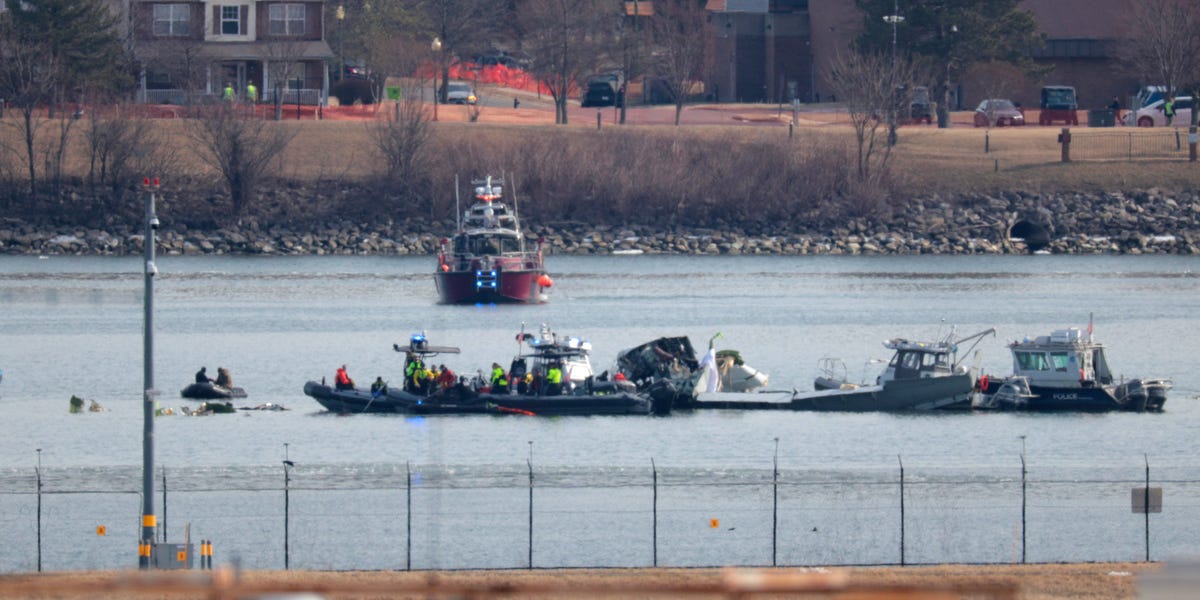
The pilots agreed, and inside minutes, the airplane collided with an Military Black Hawk helicopter. All 67 folks on board each plane died.
Enterprise Insider reviewed official briefings, flight information, and air visitors management audio recordings to piece collectively what occurred earlier than tragedy struck.
The airplane and helicopter’s ultimate moments of flight
Ronald Reagan Washington Nationwide Airport is an especially busy airspace, however officers stated it was a largely regular night time of flying. Winds had been gusty — one thing pilots are skilled for — and the skies had been clear.
The American flight had been approaching from the south, following the Potomac River alongside a well known path for pilots and frequent flyers of the DC space.
The slender hall helps separate visitors from extremely safe airspace across the White Home, Pentagon, and different authorities buildings.
Federal Aviation Administration
Seconds earlier than the American flight agreed to vary its path, one other PSA jet responded to the identical request to shift to Runway 33 as “unable,” that means it was not ready to make the adjustment.
That flight, from Montgomery, Alabama, landed on Runway 1 as deliberate and continued to its gate.
The PSA pilots of flight 5342 accepting the change is just not uncommon. Runway 33 is a shorter strip that faces Northwest and may deal with a regional plane just like the Bombardier CRJ700 the pilots had been flying.
The switch-up required the airplane to maneuver from its north-facing heading towards the Potomac’s east financial institution earlier than swinging again over the river to land.
At roughly 8:43 p.m., flight 5342 was cleared to land.
Concurrently the crew of flight 5342 was prepping for the brand new runway, an Military Black Hawk helicopter was making its approach south alongside the river’s jap shore, following a typical, printed path often called “Route 4.”
Federal Aviation Administration
A number of of those channels minimize by the DC space, permitting navy plane to coexist with industrial visitors out and in of airports.
At about 8:47 p.m., a controller requested the helicopter, name signal PAT25, if that they had “the CRJ in sight” and to cross behind it. The CRJ refers back to the regional CRJ700 plane operated by PSA.
The helicopter pilot confirmed that that they had the “plane in sight” and requested “visible separation.”
Simply seconds later, gasps from controllers may be heard on the audio tapes. ATC started canceling flight landings and diverting planes from Nationwide.
DC hearth chief John Donnelly stated emergency automobiles had been on the scene by 8:58 p.m. to start rescue operations.
Human elements are only one consideration for investigators
At a briefing Thursday, officers from the Nationwide Transportation Security Board stated groups will look at human elements as they piece collectively an entire image of the crash.
“They may research the crew efficiency and all the actions and elements that may be concerned in human error, together with fatigue, medicine, medical histories, coaching, workload, tools design, and work setting,” NTSB member Todd Inman stated. They will even be combing by the wreckage and different proof for clues as to what went mistaken.
A preliminary FAA report obtained by the New York Occasions and others stated staffing at Nationwide’s ATC tower was “not regular” on the time of the crash. The outlet reported that the controller was dealing with the duties of two folks, together with directing helicopters within the space and passenger planes touchdown and taking off.
Brian Alexander, a navy helicopter pilot and a companion at aviation accident agency Kreindler & Kreindler, instructed BI that the nighttime situations, many plane lights, and busy skies might have contributed to the disaster.
“There was one other jet on ultimate, a few different jets on ultimate, and it is conceivable the helicopter pilot was watching the mistaken plane,” he stated, emphasizing that was hypothesis at this level.
Al Drago/Getty Photographs
An airline pilot beforehand instructed BI that flying out and in of Nationwide was like “threading a needle” because of the extremely restricted corridors and heavy visitors, together with low-flying helicopters.
Sen. Tammy Duckworth, a former Black Hawk pilot, instructed reporters that navy pilots usually would not discuss on to PSA pilots on the radio, however “everybody’s listening on the identical frequency.”
She stated the PSA airplane would know that the Black Hawk was within the space however could be counting on ATC because the middleman.
“Did one of many plane stray away latitude, sideways within the airspace from the route that they had been imagined to be on? Was the Black Hawk larger than the 200 toes?” Duckworth stated. “These are all issues that the accident investigators could be .”
The NTSB stated its preliminary report is anticipated to be printed inside 30 days.
![[2-Pack] USB C Wall Charger, 50W 5-Port PD Fast USB C Charging Block,2USB C+3USB A Multiport Plug,Type C Power Adapter Brick Cube for iPhone 16/15/14/13/12/Pro Max/XS,iPad,for Switch,Samsung,Ultra 2](https://m.media-amazon.com/images/I/6113+rPNNeL._AC_SL1500_.jpg)
![[6 Pack] CLOUDY BAY 4inch Smart WiFi LED Recessed Lights,RGBCW Color Changing Recessed Lighting,Compatible with Alexa and Google Home Assistant,10W 2700K-6500K,CRI90+ Wet Location,White Finish](https://m.media-amazon.com/images/I/71j1JN-Wa3L._AC_SL1500_.jpg)