Take a look at our newest merchandise


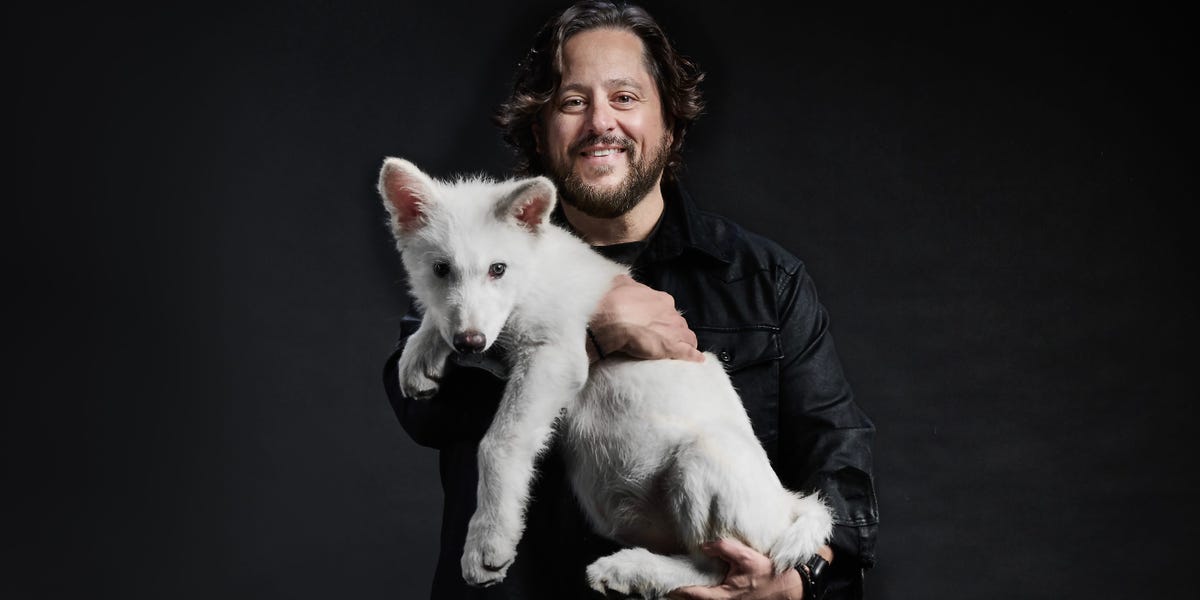
The beginnings of a real-life “Jurassic Park” are taking part in out in a high-security, undisclosed location the place three unusually giant, fluffy, white wolf pups are rising up.
The gene-editing startup Colossal Biosciences, which not too long ago raised $400 million for its de-extinction and conservation missions, introduced the pups’ existence on Monday, saying they’re the primary residing dire wolves because the species went extinct some 12,500 years in the past.
Brothers Romulus and Remus have been born in October, adopted by feminine pup Khaleesi in January — all delivered by Caesarean part from their hound-dog surrogate mothers to keep away from problems from their giant measurement.
Colossal Biosciences
“It is the primary time that we see an animal that carries a number of genes from an extinct species,” Love Dalén, a professor of evolutionary genomics who makes a speciality of mammoth DNA and sits on Colossal’s Scientific Advisory Board, informed BI in an e mail.
Colossal Biosciences says these are dire wolves. Some geneticists say they don’t seem to be.
“I would not name this the world’s first de-extinction. I’m not essentially towards the initiative, however these usually are not dire wolves,” Pontus Skoglund, a geneticist who leads an historic DNA lab on the Francis Crick Institute, informed BI in an e mail.
Even when they have been actual dire wolves, different scientists say, it will not be a good suggestion to deliver them again.
How Colossal Biosciences made its wolves
Colossal acknowledges its animals aren’t excellent genetic matches to extinct dire wolves.
Colossal Biosciences
“It isn’t attainable to create one thing that’s 100% genetically an identical in each option to a species that was once alive,” Beth Shapiro, Colossal’s chief science officer, informed BI.
For one factor, scientists haven’t got an entire genome for dire wolves. Shapiro mentioned they stuffed in some gaps by extracting extra DNA from the most effective out there samples of historic dire wolves — a 13,000-year-old tooth and a 72,000-year-old cranium.
They are saying they did an ancestral evaluation of that genome and decided, for the primary time, that the dire wolf’s closest residing relative is a grey wolf.
In the long run, Colossal says it determined to focus on 20 edits in 14 genes to make pups with the massive measurement, white fur colour, extra-muscular legs, and different key traits they assume dire wolves had.
Colossal Biosciences
These dire wolf traits have been misplaced within the lineage of canids, Lamm mentioned, so reviving the related genes “de-extincted” them.
Associated tales

Enterprise Insider tells the revolutionary tales you wish to know
Enterprise Insider tells the revolutionary tales you wish to know
The startup’s scientists created embryos from this new genome and implanted them in hound canine surrogates.
Why these ‘dire wolves’ are controversial
“Would a chimpanzee with 20 gene edits be known as human?” Skoglund requested.
Colossal Biosciences
To defend his dire wolves, Lamm pointed to the movie “Jurassic Park,” through which scientists use frog DNA to fill in gaps in historic dinosaur DNA sequences.
“Are they dinosaurs? Or are they genetically modified organisms which were engineered with historic DNA and frog DNA and all this different stuff?” he requested.
Lamm says this can be a philosophical query about the way you outline a species. Vincent Lynch, a scientist who makes use of genomics to review evolutionary historical past, disagrees.
“It isn’t a dire wolf. It is a cloned grey wolf that they transgenically modified to make it seem like what we expect dire wolves appeared like,” Lynch, who’s a professor on the College at Buffalo, informed BI. “We do not even actually know what they appeared like.”
Lynch added that the creatures in Jurassic Park wouldn’t be actual dinosaurs both. Their frog genes would possibly affect their habits. Perhaps they might hop round. Perhaps they might be capable of change intercourse like frogs, which is what occurs within the film.
“These are gray wolves with a formidable however in the end small variety of exact adjustments to their genomes,” Kevin Daly, a paleogeneticist at Trinity School Dublin, informed BI in an e mail. “It could be finest to think about these as being impressed by dire wolves.”
Colossal Biosciences
Bridging the divide between a gray wolf and a dire wolf would require extra complicated alterations, like deleting entire sections of the genome, Daly added.
Complicating issues is the truth that Colossal Biosciences has not printed this work in a peer-reviewed journal. The corporate’s CEO, Ben Lamm, informed BI it plans to submit a paper.
Daly mentioned that, and not using a scientific manuscript from Colossal, “it’s troublesome for the scientific group to scrutinize its strategy and claims.”
Colossal workers plans to watch the three animals to see how their dire-wolf genes present up because the pups mature. They’re searching for larger muscle groups and a barely totally different head form than unmodified grownup gray wolves.
“It is laborious to inform that in puppies,” Lamm mentioned.
Why de-extinction?
Lamm says the corporate is striving for “practical de-extinction,” which implies reviving the traits of historic animals like dire wolves, dodo birds, or woolly mammoths simply sufficient for the brand new animals to play the identical ecological function as their historic counterparts.
Colossal’s basic instance is a brand new woolly mammoth that may stroll the plains of the Arctic, stamping away winter snow and beating down tree progress to kind a chilly grassland. This “mammoth steppe” would, in idea, soak up extra carbon and stop permafrost from thawing, slowing the local weather disaster.
A Colossal mammoth does not should be precisely the identical as an historic woolly mammoth. It principally simply must be a cold-adapted elephant.
Dalén mentioned he sees the brand new animals as “Dire Wolf 1.0,” including that, “The work introduced right here is just the start, and exhibits that Colossal might, in precept, preserve doing edits of further genes if they need.”
Colossal Biosciences
The film “Jurassic Park” is not significantly flattering to this concept. The dinosaurs use their frog DNA to alter intercourse and reproduce, threatening to overwhelm their human captors.
With Colossal, Lynch has the same concern — not about human-eating mammoths, however about unintended penalties.
“Perhaps it does not behave like a woolly mammoth or a dire wolf,” Lynch mentioned. In any case, wolves and elephants are extremely social animals that be taught many fundamental behaviors from their dad and mom.
These “dire wolves” are the primary of their type. All they’ve is their genetics.
![[2-Pack] USB C Wall Charger, 50W 5-Port PD Fast USB C Charging Block,2USB C+3USB A Multiport Plug,Type C Power Adapter Brick Cube for iPhone 16/15/14/13/12/Pro Max/XS,iPad,for Switch,Samsung,Ultra 2](https://m.media-amazon.com/images/I/6113+rPNNeL._AC_SL1500_.jpg)
![[6 Pack] CLOUDY BAY 4inch Smart WiFi LED Recessed Lights,RGBCW Color Changing Recessed Lighting,Compatible with Alexa and Google Home Assistant,10W 2700K-6500K,CRI90+ Wet Location,White Finish](https://m.media-amazon.com/images/I/71j1JN-Wa3L._AC_SL1500_.jpg)