Try our newest merchandise


| NVIDIA GeForce RTX 5060 Ti 16GB: MSRP $429 The brand new GeForce RTX 5060 Ti brings NVIDIA’s newest Blackwell GPU structure down beneath $500, to focus on mainstream 1440p players, with peak efficiency realized in superior AI rendering strategies like DLSS4 with multi-frame technology.
|
|||

|


|
||
Keep in mind once we stated NVIDIA was launching “the ultimate member of the preliminary batch GeForce RTX 50 collection playing cards” in our GeForce RTX 5070 Founders Version overview a couple of weeks again? Properly, that wasn’t utterly true. Sure, the GeForce RTX 5070 was the final of the playing cards introduced at CES 2025, however all of us new further Blackwell-based RTX 50 collection playing cards have been coming down the pipe – NVIDIA simply hadn’t introduced them but. After taking the wraps off of the GeForce RTX 5060 household yesterday although, right here we’re already with our first overview of the 16GB GeForce RTX 5060 Ti – the quickest of the three playing cards introduced.
As its identify suggests, the GeForce RTX 5060 Ti scales the corporate’s Blackwell GPU structure down even additional versus the RTX 5070 (and better finish playing cards), to focus on extra mainstream resolutions and value factors. There are a trio of GeForce RTX 5060 playing cards coming, an 8GB GeForce RTX 5060 and 8GB and 16GB GeForce RTX 5060 Ti playing cards. It’s the top-of-the-range 16GB card that’s launching immediately, as 8GB fashions are coming a bit later, with the bottom GeForce RTX 5060 coming in Might.

NVIDIA GeForce RTX 5060 Ti Specs

We’ve acquired two units of specs to share above, for each the bottom mannequin GeForce RTX 5060 and the up-market GeForce RTX 5060 Ti. It’s the 5060 Ti numbers which might be germane to this overview, however figured we’d cowl the specs for your complete household.
Your complete GeForce RTX 5060 household is constructed across the GB206 GPU. The GeForce RTX 5060 Ti is the total implementation of the chip, whereas the RTX 5060 is scaled again considerably. The GPU is comprised of roughly 21.9B transistors and is manufactured on TSMC’s 4N node. It’s organized into 3 GPCs, with a most of 4,608 CUDA cores, 144 Tensor cores, and 36 RT cores – the scaled again RTX 5060 clearly has fewer cores enabled total. The GPU related to as much as 16GB of GDDR7 reminiscence over a 128-bit interface, at a 28GBps information charge. At that velocity, with a 128-bit interface, GeForce RTX 5060 / 5060 Ti playing cards supply peak reminiscence bandwidth of 448GB/s.

GeForce “60” Collection Multi-Era Comparability
In fact, for the reason that GB206 relies on NVIDIA’s Blackwell GPU structure, the RTX 5060 household presents all the similar options as its higher-end counterparts, together with up to date CUDA, Tensor and RT cores, DLSS 4, RTX Neural Rendering, and the most recent media encoders / decoders, with assist for {hardware} accelerated 4:2:2 video. Nearly each a part of the GPU has been up to date or enhanced not directly. For a deeper dive on the whole lot Blackwell has to supply, we recommend studying this text the place we cowl all the nitty gritty.
GeForce RTX 5060 Ti Playing cards From MSI And PNY
For the needs of this text, we acquired our palms on a few GeForce RTX 5060 Ti playing cards, one from MSI and one other from PNY. We must always level out that NVIDIA received’t offer Founders Version boards with this the RTX 5060 Ti and is as a substitute leaving this household of GPUs as much as its companions.


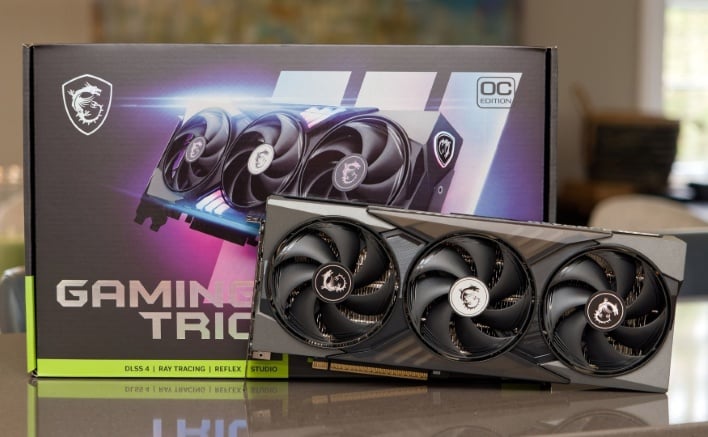
At first look, the dominant function on the MSI GeForce RTX 5060 Ti Gaming Trio, as its identify implies, is its triple-fan cooler. The cardboard includes a comparatively massive thin-fin heatsink array, with a number of heat-pipes and a nickel-plated copper baseplate. The baseplate makes direct contact with the GPU and reminiscence, and the heat-pipes are what MSI calls “core pipes”; which mainly means the pipes are squared off to maximise contact with the baseplate. The heatsink fins are additionally fashioned into curved ‘V’ shapes in a couple of sections to optimize air stream by means of the fins and decrease turbulence, which in flip lowers noise output. The followers function twin ball bearings for elevated longevity, together with 7, textured fan blades to maximise air stream and assist decrease noise. It is also a partial pass-through design, with a bit on the again that extends properly previous the precise PCB — you may see it within the shot of the again of the cardboard above.


Over and above the baseplate that’s affixed to the GPU and reminiscence, a number of thermal pads are used as properly to make sure further warmth dissipation for different vital elements on the cardboard that make contact with different parts of the heatsink. A metallic backplate on the cardboard additionally options thermal pads beneath to help in cooling.
The MSI GeForce RTX 5060 Ti Gaming Trio presents a default GPU increase clock is 2,572MHz, and packs 16GB of GDDR7 reminiscence operating at NVIDIA’s reference spec of 28Gbps. Included with the MSI GeForce RTX 5060 Ti Gaming Trio is a primary lit pack, a twin 8-pin PCIe to 12HPWR adapter, and an adjustable GPU assist stand.

Outputs on the MSI GeForce RTX 5060 Ti Gaming Trio mirror different GeForce RTX 50 collection playing cards and embody three DisplayPorts (2.1b) and a single HDMI port (2.1b). These ports are nestled into a stainless-steel backplate that options venting, to permit some heat air to flee a system. A few of the warmth pipes that snake although the heatsink are seen simply behind these vents.


The PNY GeForce RTX 5060 Ti has comparable specs and options, however has a considerably smaller kind issue and it sticks with the standard 8-pin PCIe energy connector.
Each the PNY and MSI playing cards are solely twin slot, which is a welcome improvement in mild of all the huge GPUs we’ve examined as of late. The PNY GeForce RTX 5060 Ti, nevertheless, is shorter and nowhere close to as lengthy, which ought to make it well-suited to mini-ITX or small kind issue techniques that may accommodate a discrete GPU.

You would possibly suppose {that a} smaller cooler is a nasty factor, but it surely actually isn’t. Even whereas overclocked, the PNY card’s GPU temperatures barely creep into the mid-60s. The bigger cooler on the MSI card is a bit quieter and retains the cardboard a few levels cooler, however the GB206 can completely get by with a smaller cooler, with no drawback in anyway.
And now that you just’re conversant in the playing cards we’ll be testing immediately, let’s get to the benchmarks…