Take a look at our newest merchandise


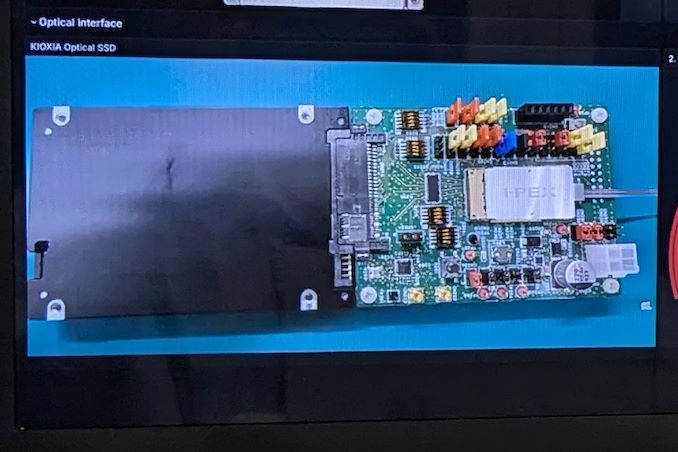
A number of years again, the Japanese authorities’s New Vitality and Industrial Know-how Growth Group (NEDO ) allotted funding for the event of inexperienced datacenter applied sciences. With the goal to acquire as much as 40% financial savings in general energy consumption, a number of Japanese firms have been growing an optical interface for his or her enterprise SSDs. And at this 12 months’s FMS, Kioxia had their optical interface on show.
For this demonstration, Kioxia took its current CM7 enterprise SSD and created an optical interface for it. A PCIe card with on-board optics developed by Kyocera is put in within the server slot. An optical interface permits information switch over lengthy distances (it was 40m within the demo, however Kioxia guarantees lengths of as much as 100m for the cable sooner or later). This enables the storage to be saved in a separate room with minimal cooling necessities in comparison with the rack with the CPUs and GPUs. Disaggregation of various server elements will turn into an choice as very excessive throughput interfaces equivalent to PCIe 7.0 (with 128 GT/s charges) turn into out there.
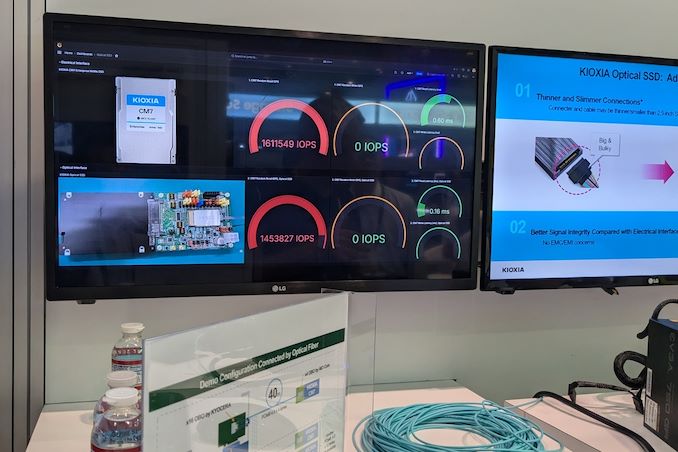
The demonstration of the optical SSD confirmed a slight loss in IOPS efficiency, however a big benefit within the latency metric over the transport enterprise SSD behind a copper community hyperlink. Clearly, there are benefits in wiring necessities and sign integrity upkeep with optical hyperlinks.
Being a proof-of-concept demonstration, we do see the requirement for an industry-standard method if this had been to achieve adoption amongst completely different datacenter distributors. The PCI-SIG optical workgroup might want to get its act collectively quickly to create a standards-based method to this drawback.