Try our newest merchandise


Japan’s authorities is battling record-low approval rankings as customers voice anger at hovering rice costs simply weeks earlier than key nationwide elections.
Makes an attempt to deliver down the value of the Japanese staple have had little impact, prompting requires a discount within the consumption (gross sales) tax to ease the cost-of-living disaster.
A brand new ballot by the Kyodo information company discovered that buyers blamed the administration of the prime minister, Shigeru Ishiba, for rising strain on family funds.
Approval rankings for Ishiba’s cupboard stand at 27.4%, in line with the ballot, the bottom since he took workplace final October and a dip of greater than 5 proportion factors prior to now month, Kyodo mentioned.
Ishiba’s ruling Liberal Democratic social gathering (LDP) has up to now dominated out a lower within the 10% consumption tax, which guarantees to be a focus of higher home elections in July.
Ishiba is already below strain after the LDP and its junior coalition companion misplaced their decrease home majority final autumn. Vital losses within the higher home will solely add to calls from opponents contained in the social gathering for him to go.
Virtually three-quarters of respondents mentioned the tax, which is levied on a variety of products and companies, must be lower “just for meals objects”, “for all merchandise” or be abolished altogether, the ballot discovered.
Extra worrying for Ishiba, simply over 87% of respondents mentioned authorities efforts to rein within the worth of rice had been “inadequate”, whereas greater than 74% mentioned they didn’t count on ongoing US-Japan tariff talks – together with negotiations on American imports of rice and different foodstuffs – to finish favourably to Japan.
Earlier this 12 months Ishiba’s authorities took the bizarre step of dipping into its huge rice reserves. In March it started releasing stockpiled rice in an try to arrest worth rises which were blamed on a mixture of things, together with increased demand fuelled partially by the tourism growth, distribution bottlenecks, and suspected hoarding by wholesalers and distributors in anticipation of additional shortages.
However the transfer, which is normally reserved for shortages attributable to pure disasters and crop failures, didn’t have the specified impact, with costs of home rice falling solely marginally.
The worth of rice bought in supermarkets averaged ¥4,214 ($29) for 5kg through the week to 4 Could, in line with the agriculture ministry. That’s ¥18 cheaper than the all-time excessive recorded every week earlier, however nonetheless round double the value on the identical time final 12 months.
In response, the federal government mentioned final week it will double the availability of stockpiled rice, with an extra 300,000 tons due for launch within the three months to July, media experiences mentioned. That’s on prime of 300,000 tons that has already been launched from emergency stockpiles since March. As well as, among the rice will bypass wholesalers so it might attain outlets extra shortly.
The mounting rice disaster has compelled extra Japanese eating places and customers to show to cheaper imports. In April, Japan imported South Korean rice for the primary time in 1 / 4 of a century.
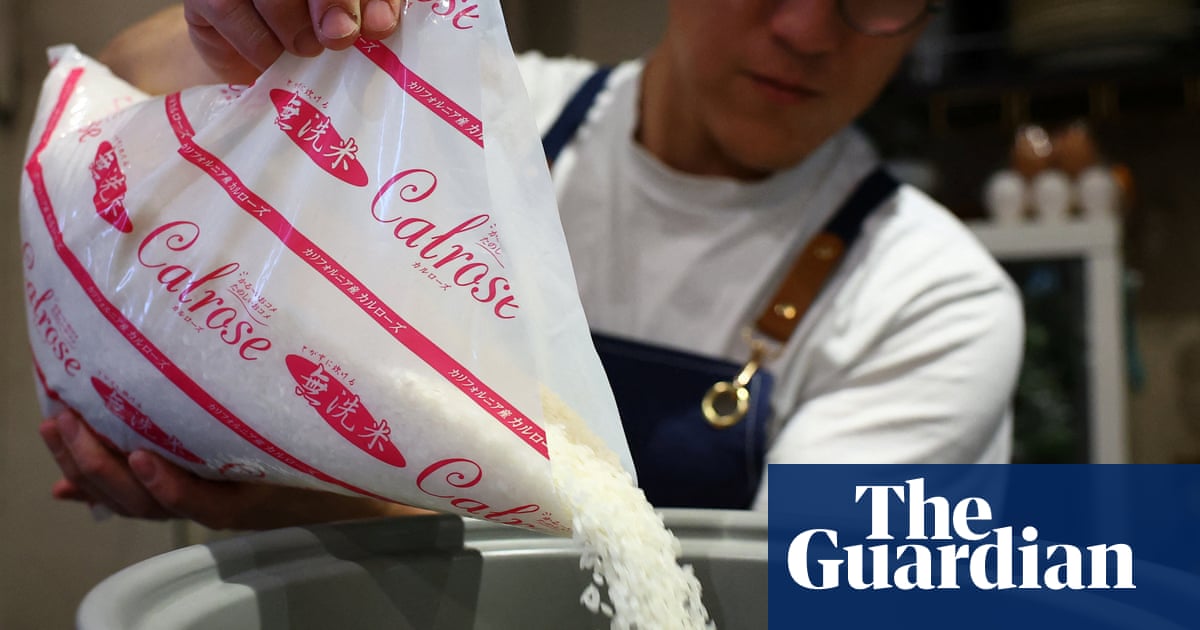
Final week, the grocery store chain Aeon mentioned it will begin promoting US-produced Calrose rice from early subsequent month. A 4kg bag will price about 10% lower than Japanese rice.
![[2-Pack] USB C Wall Charger, 50W 5-Port PD Fast USB C Charging Block,2USB C+3USB A Multiport Plug,Type C Power Adapter Brick Cube for iPhone 16/15/14/13/12/Pro Max/XS,iPad,for Switch,Samsung,Ultra 2](https://m.media-amazon.com/images/I/6113+rPNNeL._AC_SL1500_.jpg)
![[6 Pack] CLOUDY BAY 4inch Smart WiFi LED Recessed Lights,RGBCW Color Changing Recessed Lighting,Compatible with Alexa and Google Home Assistant,10W 2700K-6500K,CRI90+ Wet Location,White Finish](https://m.media-amazon.com/images/I/71j1JN-Wa3L._AC_SL1500_.jpg)