Take a look at our newest merchandise


Earlier this month, AMD launched the primary two desktop CPUs utilizing their newest Zen 5 microarchitecture: the Ryzen 7 9700X and the Ryzen 5 9600X. As a part of the brand new Ryzen 9000 household, it gave us their newest Zen 5 cores to the desktop market, as AMD truly launched Zen 5 by way of their cellular platform final month, the Ryzen AI 300 sequence (which we reviewed).
In the present day, AMD is launching the remaining two Ryzen 9000 SKUs first introduced at Computex 2024, finishing the present Ryzen 9000 product stack. Each chips hail from the premium Ryzen 9 sequence, which incorporates the flagship Ryzen 9 9950X, which has 16 Zen 5 cores and may enhance as excessive as 5.7 GHz, whereas the Ryzen 9 9900X has 12 Zen 5 cores and presents enhance clock speeds of as much as 5.6 GHz.
Though they took barely longer than anticipated to launch, as there was a delay from the preliminary launch date of July thirty first, the total quartet of Ryzen 9000 X sequence processors armed with the newest Zen 5 cores can be found. The entire Ryzen 9000 sequence processors use the identical AM5 socket because the earlier Ryzen 7000 (Zen 4) sequence, which implies customers can use present X670E and X670 motherboards with the brand new chips. Sadly, as we highlighted in our Ryzen 7 9700X and Ryzen 5 9600X assessment, the X870E/X870 motherboards, which had been meant to launch alongside the Ryzen 9000 sequence, will not be accessible till someday in September.
We have seen how the entry-level Ryzen 5 9600X and the mid-range Ryzen 7 9700X carry out in opposition to the competitors, however it is time to see how far and quick the flagship Ryzen 9 pairing competes. The Ryzen 9 9950X (16C/32T) and the Ryzen 9 9900X (12C/24T) each have a better TDP (170 W/120 W respectively) than the Ryzen 7 and Ryzen 5 (65 W), however there are extra cores, and Ryzen 9 is clocked quicker at each base and turbo frequencies. With this in thoughts, it is time to see how AMD’s Zen 5 flagship Ryzen 9 sequence for desktops performs with extra firepower, with our assessment of the Ryzen 9 9950X and Ryzen 9 9900 processors.
AMD Ryzen 9 9950X and 9900X:
From a product launch perspective, AMD usually launches its Ryzen portfolio as follows: we get the desktop processors first, then the cellular chips, and often, the workstation and server elements come a bit later. For the launch of its newest Zen 5 microarchitecture, AMD threw a curveball as an alternative. Final month, AMD opted to first deliver their cellular Ryzen AI 300 sequence to market, combining the total Zen 5 cores and compact Zen 5c cores. We did assessment the Ryzen AI 9 HX 370 cellular SoC, which gave us our first glimpse of how Zen 5 performs.
Quick-forward simply over per week, and AMD dropped two of the 4 Zen 5-based desktop chips they introduced at Computex 2024. AMD launched the Ryzen 7 9700X, an 8C/16T chip concentrating on the mid-range, and the Ryzen 5 9600X, a 6C/12T variant representing the entry-level; we additionally reviewed each of those. It additionally gave us our first take a look at how Zen 5 compares with the earlier Zen 4 structure and Intel’s present 14th Gen Core sequence household.
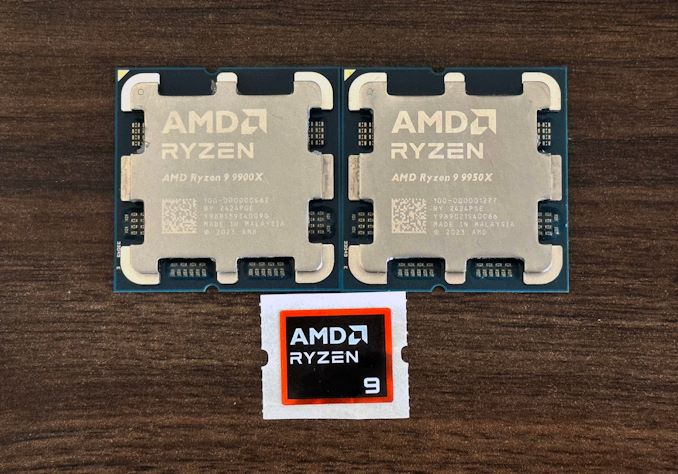
Die shot of a Ryzen 9 (Zen 5) processor with 2 x CCDs
We’ve revealed various critiques and articles previous to immediately, together with an in-depth take a look at the Zen 5 microarchitecture itself:
Specializing in the Ryzen 9 9950X and the Ryzen 9 9900X, apart from core depend, core clock speeds, and value, the primary distinction between the Ryzen 9 pairing and the Ryzen 7 9700X and Ryzen 5 9600X is the variety of lively Core Advanced Dies (CCDs) on every chip, which AMD has codenamed Eldora. For the Ryzen 9000 sequence, every CCD can assist as much as eight Zen 5 cores, with every CCD as normal (not X3D) coming with a 32 MB pool of L3 cache. Equally, L2 cache is held at 1MB per CPU core for the desktop chips. AMD’s newest Zen 5 core is constructed on TSMC’s 4nm N4P node, which is a modest step up from Zen 4. Although outdoors of CPU cores/CCDs, AMD has opted to make use of the identical I/O Die (IOD) as Ryzen 7000, which is manufactured on TSMC’s 6 nm node.
| AMD Ryzen 9000 Sequence Processors Zen 5 Microarchitecture (Granite Ridge) |
|||||||
| AnandTech | Cores / Threads |
Base Freq |
Turbo Freq |
L2 Cache |
L3 Cache |
TDP | MSRP |
| Ryzen 9 9950X | 16C / 32T | 4.3GHz | 5.7GHz | 16 MB | 64 MB | 170 W | $649 |
| Ryzen 9 9900X | 12C / 24T | 4.4GHz | 5.6GHz | 12 MB | 64 MB | 120 W | $499 |
| Ryzen 7 9700X | 8C / 16T | 3.8GHz | 5.5GHz | 8 MB | 32 MB | 65 W | $359 |
| Ryzen 5 9600X | 6C / 12T | 3.9GHz | 5.4GHz | 6 MB | 32 MB | 65 W | $279 |
The Ryzen 9 9950X makes use of two CCDs for a complete of 16 cores (32 threads), with a base frequency of 4.3 GHz and a turbo frequency of as much as 5.7 GHz; that is just like the earlier Zen 4 primarily based Ryzen 9 7950X, which additionally has a max enhance clock of as much as 5.7 GHz. The Ryzen 9 9950X additionally has 64 MB of L3 cache (32 MB per CCD), with a 170 Watt TDP.
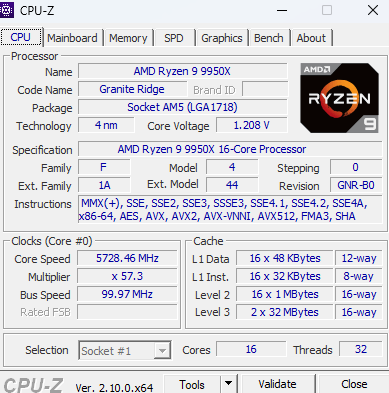
AMD Ryzen 9 9950X in CPU-Z
For the Ryzen 9 9900X, AMD has truly lowered the TDP all the way down to 120 W for his or her 12C/24T SKU in comparison with the earlier generations’ Ryzen 9 7900X, which has a 170 W TDP. Benefiting from Zen 5 cores, the Ryzen 9 9900X has a base frequency of 4.4 GHz and a turbo frequency of as much as 5.6 GHz. The Ryzen 9 9900X additionally makes use of two CCDs on the die, which provides it 64 MB (2 x 32 MB) of L3 cache.
The Return of The PPM Provisioning Driver: However There’s No 3D V-Cache, So Why?
Particularly referring to the Ryzen 9 9950X and the Ryzen 9 9900X, AMD has introduced again their PPM Provisioning driver. The final time we noticed the PPM driver was again in our Ryzen 9 7950X3D assessment, when AMD first launched it alongside their first multi-CCD X3D processor. This chip was particular as a result of one (and only one) CCD got here packaged with AMD’s 3D V-Cache, which primarily provides a big slice of L3 cache (64 MB) on high of the prevailing 32 MB of L3 cache on that CCD.
The PPM driver is a basic factor that works to make sure that the 3D V-Cache is totally utilized inside video games, which in any other case might inadvertently bypass the CCD with the additional cache. It really works by parking the ‘vanilla’ CCD, in order that the sport is operating solely on the cores from the CCD with the 3D V-Cache.
For the Ryzen 7000 technology, the PPM driver was solely required on the X3D chips with a number of CCDs, such because the Ryzen 9 7950X3D. However that is not the case anymore, it appears, as AMD is deploying it for all multi-CCD Ryzen 9000 processors.
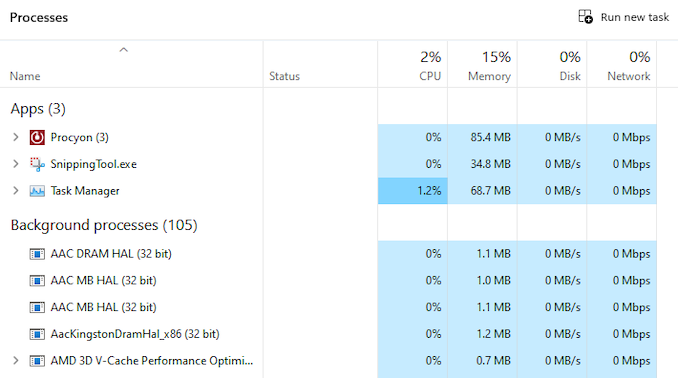
The AMD 3D V-Cache Efficiency Optimizer course of operating within the background (PPM provisioning)
The PPM Provisioning driver is bundled throughout the AMD chipset drivers (ver 6.0.6.28.910), together with the everyday Promontory motherboard chipset drivers for AM5 motherboards. In tandem with Microsoft’s Recreation Bar and Recreation Mode, the PPM driver operates when Recreation Mode is enabled. As soon as a recreation is detected to be operating, the PPM driver parks up one of many CCDs, so this primarily means when gaming, the chip is operating at half capability until a recreation deliberately spins up sufficient threads to require the second CCD. Microsoft has a complete information to its Provisioning packages, which particulars most of the advantages and situations the place it will probably profit efficiency. AMD is leveraging this in cooperation with Recreation Mode, which is enabled with the Ryzen 9 9950X and Ryzen 9 9900X.
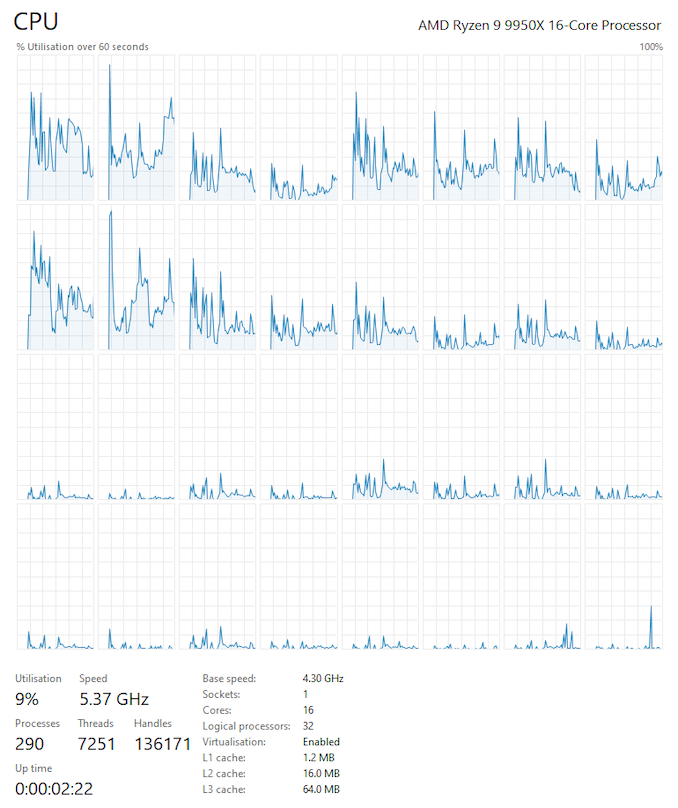
AMD Ryzen 9 9950X in Process Supervisor with one CCD fired up whereas enjoying Firm of Heroes 3
AMD has but to firmly doc why it’s utilizing the PPM Provisioning/3D V-Cache Optimizer with non-X3D chips from the Ryzen 9000 sequence. We’ve reached out to AMD for a solution, and so they responded by stating that the core parking characteristic comprises vital recreation processes in a single cache area for one of the best gaming efficiency. Whereas this can be a technically correct description of what the PPM driver is doing, it would not actually reply the query of why multi-CCD Ryzen 9000 chips have been deemed to wish this type of assist when the 7950X/7900X didn’t.
Our interpretation is that AMD has run into sufficient points on the Ryzen 7000 sequence with video games inadvertently straddling a number of CCDs, that they’ve determined it is higher to chew the bullet and use the PPM driver right here as nicely, even with the additional complexity it entails. PPM core parking on the Ryzen 9 9950X and Ryzen 9 9900X CPUs allows AMD to extra forcefully consolidate all gaming calls for inside a single cache area (single CCD), which might keep away from the latency-induced efficiency penalty of threads messaging one another from opposing CCDs or attempting to entry the L3 cache from outdoors their very own native CCD.
In essence, it could be all the identical rationale for why AMD carried out the PPM driver for the Ryzen 7000X3D chips within the first place: as a result of poor die-to-die latency, having recreation threads unfold out over a number of CCDs is unhealthy for efficiency. Although it does awkwardly counsel that the prevailing Ryzen 9 7900X/7950X processors are under-performing as a consequence of their loosely managed thread allocations, which in flip could also be why AMD would not wish to speak in regards to the subject in any element.
The opposite concept in flight is that as a result of AMD is reusing their IOD and Infinity Material from the Ryzen 7000 sequence (simply the CCDs are new), elevated useful resource rivalry has pressured AMDs hand. In different phrases, that Ryzen 7000 was positive, however the quicker CPU cores on Ryzen 9000 are simply quick sufficient to make for a big drawback that wants addressed. Both approach the end result for the Ryzen 9000 sequence is identical, however it paints Ryzen 7000 in a greater mild.
Recreation efficiency apart, the core parking characteristic additionally lowers the ability draw and helps with thermal dissipation. So AMD will likely be seeing some fringe advantages moreover simply maintaining video games from unintentionally strangling themselves by working throughout the CCDs.
| AMD AM5 Chipset Comparability | |||||
| Function | X870E | X870 | X670E | X670 | B650E |
| CPU PCIe (PCIe) | 5.0 | 5.0 | 5.0 | 4.0 | 5.0 |
| CPU PCIe (M.2 Slots) | At Least 1 PCIe 5.0 Slot | ||||
| Whole CPU PCIe Lanes | 24 | ||||
| Chipset PCIe Lanes (Max) | 4.0: 12 3.0: 8 |
4.0: 8 3.0: 4 |
4.0: 12 3.0: 8 |
4.0: 8 3.0: 4 |
|
| USB4 | Obligatory (Discrete, Consumes 4 Chipset PCie 4.0 Lanes) |
Elective | |||
| SATA Ports (Max) | 8 | 4 | 8 | 8 | 4 |
| DDR5 Help | Quad Channel (128-bit bus) | ||||
| Wi-Fi | Wi-Fi 7 (Discrete) | Wi-Fi 6E (Discrete) | |||
| CPU Overclocking Help | Sure | ||||
| Reminiscence Overclocking Help | Sure | ||||
| # of Chips | 2 | 1 | 2 | 2 | 1 |
| Silicon | ASMedia Promontory 21 | ||||
| Obtainable | Anticipated Sept. 2024 | Anticipated Sept. 2024 | Sept. 2022 | Sept. 2022 | Oct. 2022 |
As we highlighted in our Ryzen 7 9700X and Ryzen 5 9600X assessment, the Ryzen 9000 sequence makes use of the AM5 socket, very like the Ryzen 7000 sequence does. Whereas there is a wave of latest motherboards primarily based on the X870E and X870 chipsets coming to market, these aren’t anticipated till September. All the present AM5 socket motherboards in the marketplace, resembling X670E and X670 fashions, are suitable with Ryzen 9000, so customers needn’t wait. The incoming X870E/X870 motherboards and the present X670E/X670 use the identical ASMedia Promontory 21 chipset, so the one distinction is within the characteristic set.
The newer boards make the most of new controllers resembling Wi-Fi 7, to not point out that X870E/X870 additionally consists of USB 4.0 assist, which will likely be ubiquitous on all X870(E) boards, the place it was beforehand solely optionally available for X670(E) sequence boards. There will even be a requirement to characteristic a minimum of one PCIe 5.0 NVMe slot, which can proceed to be a compulsory inclusion. AMD additionally notes that motherboards primarily based on each platforms “characteristic 44 whole PCIe lanes,” which might break all the way down to 24 lanes from the CPU and one other 20 lanes from the chipset.
Concerning pricing, your entire Ryzen 9000 sequence line-up is launching at a less expensive value than the counterpart from the Ryzen 7000 sequence it’s changing. The flagship Ryzen 9 9950X has an MSRP of $649, which is $50 cheaper than the Ryzen 9 7950X when launched again in 2022. The Ryzen 9 9900X can also be $50 cheaper at launch than the Ryzen 9 7900X got here at, with the 9900X having an MSRP of $499. Even going again to when AMD launched Zen 3 with the Ryzen 5000 sequence in 2020, AMD is constantly bringing costs down on every subsequent SKU, which exhibits AMD is much more aggressive in pricing with every technology we have seen.
Now that AMD has launched the flagship Ryzen 9 chips, we are able to lastly see how AMD’s greatest Zen 5 desktop chips stack up in opposition to the competitors.
![[2-Pack] USB C Wall Charger, 50W 5-Port PD Fast USB C Charging Block,2USB C+3USB A Multiport Plug,Type C Power Adapter Brick Cube for iPhone 16/15/14/13/12/Pro Max/XS,iPad,for Switch,Samsung,Ultra 2](https://m.media-amazon.com/images/I/6113+rPNNeL._AC_SL1500_.jpg)
![[6 Pack] CLOUDY BAY 4inch Smart WiFi LED Recessed Lights,RGBCW Color Changing Recessed Lighting,Compatible with Alexa and Google Home Assistant,10W 2700K-6500K,CRI90+ Wet Location,White Finish](https://m.media-amazon.com/images/I/71j1JN-Wa3L._AC_SL1500_.jpg)